
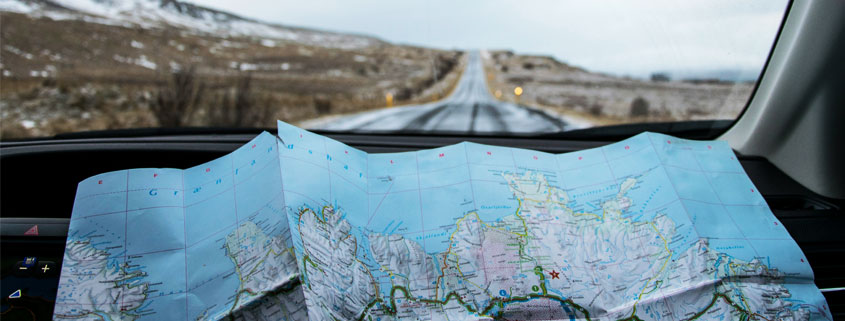
The first time you turn off turn by turn directions in an unfamiliar city, you feel a small flare of panic that is almost comic in its intensity. Nothing has changed in the street. The buildings are still there, the pavement still holds, the buses still arrive, the café still sells espresso to strangers. Yet the mind reacts as if a support beam has been removed. You realize how thoroughly the modern traveler has outsourced orientation, not merely to a map, but to a decision engine that chooses routes, filters options, and edits reality into a single acceptable path.
Travel has always promised freedom, but many contemporary trips are built on invisible rails. The algorithm decides which neighborhood is “worth it.” The app determines which side street you will never see. The phone becomes a private guide whose greatest strength is also its quiet theft, it prevents you from forming a relationship with place that includes uncertainty.
Navigating without GPS is not a rejection of technology, and it is not a costume of ruggedness. It is a conscious choice to experience travel as a wayfinding practice, a cognitive act, and a moral stance. It gives you back something that feels oddly rare now, the sensation of being inside a city rather than moving across it.
The Map in Your Head Is the Real Souvenir
Most souvenirs are purchased, displayed, and eventually forgotten. A mental map is different. It changes how you remember, and it changes what you become capable of noticing later in life.
When you follow turn by turn directions, you can arrive at a destination without ever understanding where you are. Your body moves, your mind remains abstracted, and the route evaporates as soon as you reach the endpoint. You remember a few landmarks, usually the dramatic ones, but you do not gain a sense of structure. You are a passenger in your own travel.
When you navigate actively, the brain builds what psychologists call a cognitive map, an internal representation of spatial relationships. This map is not a perfect grid. It is lumpy, emotional, anchored to smells and sounds and moments of decision. It is also astonishingly durable. Years later you may not recall the name of a street, yet you will remember how the light falls when you turn left at the square, and how a particular incline leads toward water, and how the city seems to breathe differently on one side of a ridge.
That internal map becomes part of your memory architecture. It influences how you tell stories. It gives you a felt sense of the city’s logic, not just its highlights. It makes the place yours in a way that no itinerary can replicate.
GPS Did Not Only Solve a Problem, It Changed the Definition of Travel
It is tempting to frame GPS as a simple improvement. Before, people got lost. Now, people do not. That framing misses the deeper shift. GPS transformed travel from exploration into execution.
Execution is efficient. It gets you from hotel to museum to restaurant with minimal friction. It also reduces travel to a series of tasks. The day becomes a checklist. The city becomes a board game with pieces you move between recommended squares.
Exploration is slower and less predictable. It creates waste in the economic sense, time spent walking in the wrong direction, time spent pausing, time spent recalibrating. Yet that waste is the raw material of discovery. Many of the most vivid travel memories are not of the primary attraction. They are of the wrong turn that revealed a market, the accidental street festival, the small staircase that led to a view you did not know you wanted, the conversation that occurred because you had to ask for help.
GPS narrows the range of what is likely to happen, not because it forbids surprise, but because it reduces the conditions that produce surprise. It is a tool that makes the world more legible while making you less attentive.
Getting Lost Is Not the Same as Being Unsafe
A serious conversation about navigating without GPS must acknowledge the obvious. People have different risk tolerances, different bodies, different histories, different reasons to protect themselves. Some travelers face harassment, surveillance, discrimination, or threats that others can ignore. Some have disabilities that make wandering physically costly. Some travel with children. Some are in places where wrong turns can be dangerous.
The argument is not that everyone should abandon assistance. The argument is that there is a spectrum between blind wandering and algorithmic obedience, and most people never explore the middle.
You can choose to navigate actively while remaining careful. You can use a paper map to understand the city’s bones, then use a phone only when you need precise confirmation. You can wander within boundaries, choosing neighborhoods where you feel safe, keeping a mental note of transit hubs, storing offline maps as a backup rather than a constant guide. You can ask a hotel concierge for areas to avoid at night. You can plan your day around daylight, not bravado.
The goal is not to romanticize vulnerability. The goal is to reclaim agency.
Paper Maps Teach a City’s Shape in a Way Screens Often Do Not
A phone map is a miracle, yet it is also a narrow window. It shows you where you are, but it rarely forces you to understand where everything else is. You zoom in, you follow the line, you arrive. The screen hides the whole.
A paper map, or even a static map viewed at a broader scale, does something psychologically important. It forces you to see relationships. You notice which neighborhoods touch. You see rivers as barriers and bridges as funnels. You understand how train lines distribute foot traffic. You begin to anticipate where density will be, where quiet will be, where the city’s commercial spine runs, where its edges dissolve into hills or industrial zones.
This does not just help you get around. It changes what you choose. You might decide to walk along a ridge because you see it connects two districts in a way that promises views. You might choose to cross a park because it forms a green seam through the city. You might realize that the museum you planned to visit is geographically near a street market you did not know existed, and you can link them without “optimizing” anything.
Paper maps are less precise and more truthful. They reveal the city as a whole organism rather than a series of instructions.
The Most Important Navigation Skill Is Not Direction, It Is Orientation
Orientation is the feeling of where you are in relation to the whole. Direction is simply where you should go next. GPS is excellent at direction. It is mediocre at orientation, because it encourages you to offload the mental work that creates it.
Orientation begins with a few basic anchors. Where is north in this place, not as a compass point, but as a felt reference. Where is the water, if there is water. Where is the highest ground. Where does the city become denser. Where are the major transit lines. What is the dominant axis of movement.
Once you have anchors, the city becomes easier to read. Streets stop feeling like random corridors and start feeling like parts of a pattern. You can make guesses, and the guesses get better. You can be wrong without being lost in a catastrophic sense, because you understand how to recover.
This is why navigating without GPS is strangely calming after the initial discomfort. It returns you to a mode of attention that humans evolved for. You become an animal reading terrain again, not a user following prompts.
Landmarks Are Not Only Visual, They Are Sensory
Tourists often think of landmarks as monuments. In active navigation, landmarks become more subtle and more personal. A bakery that smells like toasted sesame becomes a corner marker. A street with loud traffic becomes an auditory boundary. A sudden shift in pavement texture becomes a cue that you crossed into an older quarter. A row of plane trees becomes a green corridor you can recognize even at dusk.
These sensory landmarks create a richer relationship with place. They also make travel memories more embodied. Years later you might recall the metallic scent near a train yard or the way a particular alley amplifies footsteps, and those sensations will bring back a whole afternoon.
GPS tends to strip this out because it treats the route as abstract. You could follow the same instructions in any city. Active navigation teaches you to notice what makes this city irreducible.
Asking for Directions Is a Cultural Exchange, Not an Inefficiency
One of the quiet losses of GPS travel is the disappearance of small interactions that require humility. Asking for directions is a form of social contact that is unusually honest. You admit you do not know. You ask someone to share local competence. You give them a chance to be generous.
These interactions also teach you something about the place beyond the route. In some cities, people will walk with you for a block. In others, they will gesture dramatically. In others, they will give you a reference that makes sense only if you already understand the city’s mental map, “go past the old cinema, then keep going until the street widens.” You learn what locals use as reference points, which reveals what they consider central. You learn which landmarks matter in everyday life, not just in tourist brochures.
There is also a moral dimension. GPS travel can make you a ghost. You move through neighborhoods without speaking to anyone except service workers. You consume. You leave. Asking for directions, when done respectfully, breaks that pattern. It reminds you that places are inhabited, not staged.
The City Changes When You Stop Optimizing It
Optimization is seductive. It promises you will not waste time. It promises you will see more. It promises you will win at travel.
Yet many cities are not best experienced through efficiency. Their value lies in rhythm, in the way streets gradually shift, in the transition zones between districts, in the unplanned pause. When you chase “top sites,” you often miss the connective tissue that makes a city feel coherent.
Active navigation creates space for drift, not in the careless sense, but in the attentive sense. You allow yourself to be pulled by something small, a bookstore window, a conversation, a staircase, a sound. You can still have a plan, but the plan becomes a skeleton rather than a cage.
This is not a romantic argument against planning. It is an argument against believing that the map’s shortest line is the day’s best line.
Traveling Without GPS Exposes Your Relationship With Control
Some people hate wandering because it makes them anxious. Others love wandering because it makes them feel alive. Both reactions reveal something about control.
Travel already disrupts control. You do not know the language fully. You do not know the customs. You do not know which door is the entrance. GPS can act like a prosthetic control device, giving you a sense that at least one part of the experience will behave predictably.
Turning it off forces you to meet your own discomfort directly. It shows you how quickly you interpret uncertainty as danger, even in safe contexts. It shows you how much of your travel stress is not external but internal, a fear of looking foolish, of wasting time, of making an error that feels irreversible.
The reward is not only better navigation. The reward is a quieter nervous system over time. When you learn that you can be uncertain and still be fine, the whole travel experience becomes less brittle.
The Ethics of Routing and the Crowd You Never See
GPS does not only direct individuals. At scale, it reshapes cities. When routing apps send large flows of pedestrians and drivers down certain streets, those streets change. Businesses adapt. Quiet areas become crowded. Residential lanes become traffic corridors. The city’s lived experience shifts under the weight of invisible decisions made by optimization systems.
As a traveler, you usually feel this only as convenience. Yet the ethical question is real: are you willing to let an algorithm decide where you go if that decision contributes to over-tourism in fragile areas and neglect in others. Are you willing to be steered toward the same photogenic corridors as everyone else, turning certain neighborhoods into theme parks while other neighborhoods remain invisible.
Navigating without GPS, even partially, can be a small act of decentralization. It can distribute your presence. It can lead you to places that are not viral. It can reduce your dependence on the routes that platforms reinforce.
This is not about being contrarian. It is about recognizing that your movement has effects, and that automated routing is not neutral.
The Language of Direction Is Also the Language of Place
Some cities are easy to navigate because they have a simple grid. Others feel like labyrinths because they grew organically. In both cases, local directional language reveals history.
A grid city encourages coordinate thinking. You count blocks. You understand north-south axes. You rely on numbers. A more organic city encourages landmark thinking. You navigate by squares, markets, hills, bridges, and bends. You learn names that reflect history, trades, religious sites, gates that no longer exist, families that once owned land.
When you navigate actively, you absorb this language. You begin to understand why a street is called what it is. You notice that multiple streets reference the same vanished wall or river path. You realize that the city’s memory is embedded in its directions.
GPS reduces all this to geometry. It gives you distance and arrival time. Active navigation gives you narrative, which is the deeper point of travel in the first place.
The Practical Art of Partial Disconnection
There is a mature way to travel without GPS that avoids the fantasy of purity. It looks like this: you study the area in advance, not to plan every hour, but to understand the city’s structure. You identify a few anchors, a river, a central square, a main transit line, a ridge. You choose a neighborhood to roam. You carry a small paper map or a printed screenshot with key reference points. You decide when you will allow yourself to check the phone, and you treat it as confirmation rather than command.
In this approach, the phone becomes a tool you consult, not a voice you obey. You return to the older relationship travelers had with maps, where navigation was a dialogue between the world and your attention. The technology supports the dialogue instead of replacing it.
Over time, you may find that you check less often, not because you are trying to prove something, but because the city becomes more readable. You become less dependent. That is the real victory, and it is quiet.
The Lost Pleasure of Arrival by Understanding
There is a particular satisfaction in reaching a destination you found through your own reasoning. It is different from arriving through directions. It feels earned, not as an achievement badge, but as a cognitive completion. You understand why you are there. You know what lies behind you. You know what you passed. You know the texture of the route.
This is why travel can feel strangely empty when everything is navigated by instruction. You may see many sights, yet the day can feel like it happened to you rather than through you. The city becomes a series of snapshots rather than a landscape you inhabited.
Arrival by understanding turns travel into a form of learning that is bodily, emotional, and intellectual at once. It is not academic knowledge. It is knowledge that makes you more capable, not just more informed.
Travel Becomes More Personal When It Is Less Documented
Modern travel often feels like content production. People plan based on what will photograph well. They move quickly to capture scenes. They follow routes that are already proven to be shareable. Navigation apps fit neatly into this because they streamline the content pipeline.
Travel without GPS is harder to package. It produces less predictable visuals. It can take you away from the standard angles. It creates private moments you might not capture because you were too busy orienting yourself and noticing.
That privacy is not a loss. It can be the beginning of a more honest travel life, where the trip exists primarily as lived experience rather than as evidence. Navigation becomes part of that honesty because it keeps you inside the world rather than hovering above it with a screen.
When you stop outsourcing your movement, you stop outsourcing your attention, and attention is the substance travel is made of.
The City You Learn to Read Stays With You
The most meaningful travel changes are not always about where you went. They are about what you practiced while you were there. Navigating without GPS practices a form of patience that is rare now. It practices observation. It practices humility. It practices trust in your own ability to recover from small mistakes. It practices conversation with strangers. It practices choosing curiosity over control.
Those practices do not remain in the city you visited. They return with you. You notice your own neighborhood differently. You rely less on prompts. You feel less helpless when plans shift. You become more willing to walk without a purpose and let the environment teach you something.
In a world that increasingly routes people through curated paths, the ability to move by judgment and perception becomes a small form of independence. It is not dramatic. It is not heroic. It is simply the refusal to let travel become another activity performed inside rails you did not design.

