
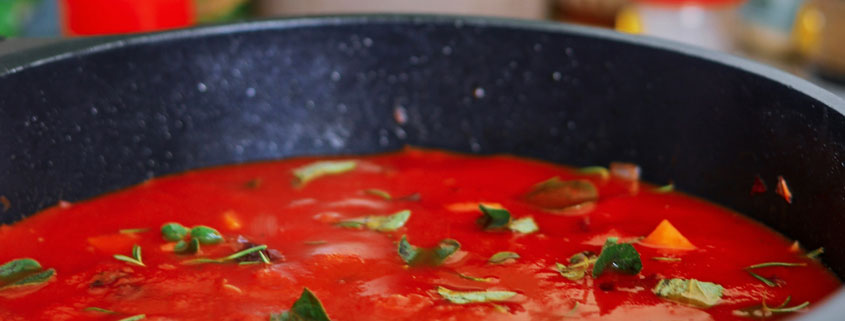
A sauce that splits does not fail quietly. It exposes its mechanics in front of everyone, like a magician whose sleeve catches on a nail. One second the spoon drags through something glossy and coherent, the next it moves through an oily puddle that looks embarrassed to be on the plate. The flavor might still be there, even the ingredients, but the illusion is gone, and with it the sense that the dish was inevitable. A broken emulsion has a particular cruelty, because it is not undercooked or burnt or oversalted. It is simply no longer held together.
That “held together” feeling is not cosmetic. It is one of the most powerful forces in food and drink, and it appears in places people do not label as sauces. Creamy soups. Vinaigrettes that cling. Chocolate ganache. Hollandaise. Aioli. Ice cream. Tahini dressings. Nut milks. Coconut curries. Even the foam on a cappuccino. They are all negotiations between substances that do not naturally want to stay married.
Emulsions are where culinary craft becomes visible. They are also where a cook can learn control without needing luxury ingredients. When you understand what makes an emulsion stable, you stop treating separation as fate and start treating it as a predictable outcome of physics, chemistry, and timing.
What an Emulsion Really Is, and Why It Feels Like Richness
An emulsion is a mixture of two liquids that normally refuse each other, most commonly fat and water. In an emulsion, one liquid is broken into tiny droplets and suspended in the other. The key word is suspended. Without help, droplets collide, merge, and separate, returning to the old hierarchy of oil floating above water.
The mouth experiences a stable emulsion as richness, not only because fat is present, but because the fat is distributed. Tiny droplets coat the tongue and carry aroma, yet they do so evenly, creating a unified sensation rather than a greasy smear. This is why a good mayonnaise tastes round instead of oily, why a well-made vinaigrette tastes bright without feeling harsh, why a cream sauce can feel plush rather than heavy.
Droplet size matters. Smaller droplets create more surface area and a more stable feel. They also change how flavor releases, because aroma compounds often dissolve into fat and then release as the emulsion warms in the mouth. A stable emulsion becomes a slow delivery system. It extends pleasure without shouting.
This is the secret behind many foods people call “comforting.” The comfort is frequently structural. The palate relaxes when the texture is coherent.
The Thin Skin That Keeps Oil and Water From Reuniting
A stable emulsion needs a mediator, something that can interact with both oil and water. In kitchen terms, this mediator is often an emulsifier, a substance that lowers the tension between oil and water and helps droplets stay separate.
Egg yolk is famous because it is effective. It contains lecithin and other compounds that behave like diplomatic agents, one side attracted to water, the other to fat. Mustard works too, partly because of compounds in mustard and partly because its fine particles help stabilize the mixture. Honey can assist in some dressings because it adds viscosity and contains compounds that can support stability. Garlic, when smashed into a paste, can help emulsify oil into a mixture because its solids and natural compounds contribute structure, which is part of why traditional aioli can work without egg.
Stability is not only about emulsifiers. It is also about thickness. A more viscous continuous phase slows droplet movement, reducing collisions. This is why some sauces rely on starch or reduction to help them stay together. It is why a dressing can separate quickly when it is thin and reunite slowly when it has body.
A good emulsion is not simply oil plus water plus an emulsifier. It is oil droplets, water phase, an interface, and a tempo. Every choice you make changes that tempo.
Shear, Patience, and the Violence You Apply With a Whisk
To make an emulsion, you must break one liquid into droplets and disperse those droplets through the other. That requires shear, the force that tears larger blobs into smaller ones.
A blender applies high shear. It can produce tiny droplets quickly, which often means stable emulsions with a thick, smooth mouthfeel. A whisk applies lower shear, but it offers control. You can build a sauce gradually, watching texture change in real time. A mortar and pestle applies shear through grinding, producing emulsions with a different tactile character, often slightly more rustic and aromatic because solids are integrated rather than pulverized into uniformity.
The rate at which you add oil matters because droplets must be stabilized as they form. If you pour oil too quickly into a watery phase, you create large droplets faster than the emulsifiers can manage, and those droplets find each other and merge. When you add oil slowly, you give the interface time to form around each droplet. The emulsion thickens, droplet movement slows, and stability improves.
This is why mayonnaise recipes insist on a thin stream of oil. It is not ritual. It is droplet management. It is also why a cook can sometimes rescue a broken sauce by starting a new base and slowly whisking the broken mixture into it, essentially re-emulsifying the fat into a system that has regained its interface capacity.
Emulsions reward calm. They also punish impatience in a way that is hard to talk yourself out of once the separation begins.
Temperature Is Not a Background Variable, It Is a Lever
Many emulsion disasters are temperature disasters that appear as texture problems.
Heat changes viscosity. It can thin a sauce, allowing droplets to move faster and collide more often. It can also alter proteins and emulsifiers, which can be helpful or destructive. In hollandaise, the egg yolk proteins thicken as they warm, giving the sauce body, yet too much heat can scramble the eggs, creating graininess and forcing separation.
Butter-based emulsions carry an additional risk because butter is itself a delicate system of fat, water, and milk solids. Clarified butter behaves differently than whole butter because water and solids have been reduced. That can make certain emulsions more stable, yet it can also change flavor and texture. Whole butter introduces water into the system, which can be either beneficial for dispersion or harmful if it destabilizes the balance.
Cold can destabilize too, especially if fats begin to solidify. An emulsion can feel smooth when warm and then become grainy when chilled because fat crystals form and disrupt the droplet structure. Chocolate ganache can seize if the temperature difference between chocolate and liquid is wrong. Some vinaigrettes thicken unpleasantly in the refrigerator because the oil becomes sluggish and separates in a new way.
Temperature control is not about precision for its own sake. It is about keeping the system inside a zone where droplets can be created and maintained without turning into puddles.
Vinaigrette Is the Most Underestimated Emulsion in the World
Vinaigrette is treated as simple. Oil, vinegar, salt, shake. Yet vinaigrette reveals nearly everything about emulsions, because it has so few places to hide.
A poorly made vinaigrette tastes like two liquids arguing. The acid hits sharply, then oil coats the mouth, then the flavors drift apart. A well-made vinaigrette tastes like a single thing, bright yet rounded, sharp yet integrated, clinging rather than sliding.
The difference often comes from droplet size and viscosity. A vinaigrette with tiny droplets feels creamy without cream. A vinaigrette with larger droplets feels slick and fleeting. Mustard, shallots, garlic paste, yogurt, tahini, or even finely grated cheese can stabilize a vinaigrette by adding emulsifiers, solids, or thickness. Even the act of whisking longer can change the experience because smaller droplets create a fuller mouthfeel.
There is also timing. Salt dissolves in the water phase. If you add salt to oil first, it sits as grains. If you dissolve it in vinegar or lemon juice first, seasoning spreads. That alters perception, not by changing sodium content, but by changing distribution. Acid can be tuned in the same way. A vinaigrette can be built with multiple acids, vinegar plus citrus, for layered sharpness that feels less linear. Sweetness can be subtle and structural, not dessert-like, used to soften edges and help stability.
Vinaigrette is where a cook can practice emulsion control daily, and it pays back in every salad, every roasted vegetable, every grain bowl that needs to taste composed instead of assembled.
Mayonnaise Is a Masterclass in Density and Risk
Mayonnaise looks like a simple white sauce until you remember what it contains. A typical mayonnaise holds a startling amount of oil in a relatively small amount of water, bound by egg yolk and technique. That is why it feels thick, why it can support other flavors so well, and why it is fragile when treated casually.
A good mayonnaise has a particular density. It can be spread, not poured. It has sheen without greasiness. It tastes round, not oily. That roundness is droplet distribution, the fat divided and stabilized so thoroughly that the mouth experiences it as a unified cream.
When mayonnaise breaks, it usually breaks in a familiar way. Too much oil added too quickly, not enough emulsifier, a base that was too cold or too warm, a mixture that did not have enough water phase to accept more fat. Sometimes it breaks because a blender overheated the mixture and altered proteins. Sometimes it breaks because the egg yolk was too small relative to the oil volume.
The interesting part is that mayonnaise teaches an emotional skill. It teaches you to accept gradualism. You must add oil slowly, read texture, adjust, then proceed. In a culture that often rewards speed, mayonnaise rewards attention.
Mayonnaise also teaches that flavor is not only what you add, but what the structure allows you to perceive. A garlic mayo tastes different than garlic mixed into oil and lemon because the emulsion changes how garlic’s sulfur compounds are presented, how aroma releases, how heat is perceived, how acidity feels.
Mayonnaise is not just a condiment. It is an edible demonstration of how structure becomes taste.
Dairy Emulsions and Why Cream Feels Like a Shortcut
Cream feels effortless because it is already an emulsion. Milk fat exists in droplets stabilized by proteins and membranes. When you add cream to a sauce, you are borrowing a system that is already stable.
Yet dairy emulsions have their own vulnerabilities. Heat can cause proteins to coagulate. Acid can curdle milk if the pH shifts too far. A cream sauce can split if boiled aggressively, especially if it is reduced too hard, because fat can separate and proteins can tighten.
The culinary trick is that many classic techniques are really about stabilizing dairy emulsions under stress. Adding cream later rather than earlier can prevent excessive reduction and splitting. Keeping heat gentle maintains stability. Using starch can help stabilize a dairy sauce by thickening the water phase and reducing droplet collisions. Mixing dairy with acid gradually can prevent curdling, giving proteins time to adjust.
Cheese sauces provide an even clearer example. Melted cheese can become stringy or oily because proteins and fats separate under heat. The classic solutions, using certain melting cheeses, controlling heat, adding starch or emulsifying salts in processed cheeses, are all strategies for keeping fat dispersed and proteins cooperative.
Dairy gives you a head start, but it does not remove responsibility. It simply changes the kind of attention required.
The Emulsions You Eat Without Realizing
Some emulsions are obvious, like mayonnaise. Others hide in plain sight.
A smooth nut butter is an emulsion-like suspension, fat and solids interacting in a way that can separate if untreated. Tahini can seize when water is added too quickly, turning from fluid to stiff paste, then, with more water and mixing, it can loosen into a creamy sauce. That behavior surprises people because they expect water to thin. What is happening is that initial water addition causes particles to clump, thickening the system, and further water addition allows the mixture to reorganize and become smooth. Tahini teaches that texture is not linear. The system can pass through an ugly stage on the way to coherence.
Coconut milk can split in curries, especially under harsh heat, because coconut fat separates. Some cuisines lean into this, allowing coconut oil to rise and fry aromatics, creating a different flavor profile. Others aim for a smooth curry, controlling heat and using agitation to maintain dispersion. Neither approach is inherently correct. Each is a choice about whether separation is a flaw or a technique.
Chocolate is another world of emulsions. Ganache is a negotiation between cocoa butter and water-based cream. A glossy ganache depends on droplet distribution and temperature control. If it breaks, it often looks like greasy chocolate tears. If it succeeds, it looks like silk.
Even ice cream is an emulsion, along with being a foam and a frozen system. It contains fat droplets, air bubbles, ice crystals, and sugar, all held in a delicate balance. Its best versions feel smooth because the ice crystals are small and because fat is dispersed in a way that creates creaminess even at low temperatures.
Once you start seeing emulsions everywhere, the kitchen stops feeling like a collection of unrelated recipes and starts feeling like a set of repeating physical problems with different costumes.
Why Some Emulsions Feel Light and Others Feel Heavy
Two emulsions can contain the same fat content and feel completely different. The difference can come from droplet size, viscosity, and the kind of fat involved.
A vinaigrette with tiny droplets can feel light because acid remains present and the fat is distributed in a way that does not coat the mouth too heavily. A mayonnaise can feel heavy because it is designed to coat, and because the ratio of oil to water is high. A hollandaise can feel luxurious rather than heavy because it is warm, aromatic, and often paired with acid that brightens perception.
Fat type matters too. Olive oil has a different mouth-coating behavior than neutral oils because it contains compounds that contribute bitterness, fruitiness, and a sense of viscosity. Butterfat melts at body temperature in a way that can feel particularly luscious. Coconut fat can feel waxier at cooler temperatures, changing texture dramatically as it warms.
Emulsions are not only texture. They are a way of shaping how fat occupies the mouth. They can be designed to linger or designed to vanish. They can be built to cushion spice heat or to sharpen acidity. They can carry herbs and aromatics as if they were trapped in velvet.
This is why sauces are not merely “added flavor.” They are added structure, and structure changes what the palate is capable of noticing.
The Emotional Discipline of Fixing a Broken Emulsion
A broken emulsion invites panic, and panic makes it worse.
The instinct is to add more heat, more whisking, more force, as if intensity can bully molecules into agreement. Often, the fix is gentler. Introduce a small amount of water phase, sometimes a spoonful of warm water or lemon juice, and whisk to rebuild the interface. Lower the temperature. Let the mixture calm. Start a new base and incorporate the broken sauce gradually. Shift the system back into a zone where droplets can become stable again.
This matters beyond the sauce itself. Emulsions teach a broader kitchen temperament. They reward the cook who watches, listens, and adjusts. They expose the cost of rushing. They also offer a particular satisfaction when rescued, because the rescue feels like understanding made visible.
A successful emulsion is one of the few culinary accomplishments you can see in real time as it happens. The mixture thickens, becomes glossy, changes color slightly, begins to hold shape. It looks like cohesion forming. That visual feedback is rare in cooking, and it is addictive.
The Deeper Point: Emulsions Are How We Make Complexity Coherent
Many dishes fail not because ingredients are bad, but because they never become a single thing. They remain components. Acid sits apart from fat. Aromatics sit apart from salt. Heat sits apart from sweetness. The eater experiences the dish in fragments.
Emulsions are one of the most effective tools for preventing fragmentation. They bind not only liquids, but experiences. They turn sharpness into brightness. They turn richness into silk. They turn scattered flavors into a conversation that sounds like one voice.
This is why learning emulsions changes how you cook even when you are not making sauces. You begin to think about cohesion. You begin to ask whether a dish is integrated or merely piled. You begin to notice where a little structure could make the difference between food that tastes correct and food that feels inevitable. A kitchen becomes more ambitious the moment you realize that oil and water do not hate each other. They just require diplomacy, and the diplomacy tastes like control.

What makes this resonate is how clearly it frames emulsions as truth tellers. When a sauce breaks, it is not just a technical failure, it reveals impatience, temperature misjudgment, or imbalance. The visual collapse feels honest in a way few kitchen mistakes do.
The section on temperature being a lever really helped. So many sauce problems come from heat being just a little too aggressive.
That line about separation not being fate is great. It’s encouraging, because it makes sauce skills feel learnable.
This article made me appreciate how much “glossy and coherent” actually means in a kitchen. It’s a sign of control.
The part about droplet size changing richness is fascinating. It explains why some sauces feel luxurious even when they aren’t heavy.
I love the idea that comfort food is often comforting because of structure, not just flavor. That feels very true.
The comparison to a magician being exposed is brilliant. When it breaks, you can’t pretend everything is fine anymore.
This makes me want to practice mayonnaise just to build patience. It’s honestly one of the best lessons in slowing down.
I never realized how much vinaigrette depends on technique until reading this. The difference between “mixed” and truly emulsified is huge.
The way this connects texture to confidence in cooking is spot on. A stable sauce feels calm, and a broken one feels like panic on a plate.
I’ve had that hollandaise moment where everything suddenly turns oily, and this article describes it perfectly. It really is instant and obvious.
This was such a satisfying explanation of why emulsions matter. It’s not just sauce; it’s the whole feeling of the dish staying together.
The part about temperature and patience really stands out. It makes you realize how many kitchen problems are actually timing and control problems, not ingredient problems. Great breakdown of something every cook has dealt with.
I love how you describe emulsions as “held together” and not just decoration. Once a sauce breaks, it proves how much structure matters, even when the flavor is still there.
This article explains sauce-breaking perfectly. That moment when everything turns oily and separated really does feel like the whole dish gets exposed. It’s not just visual, it changes the entire experience.