
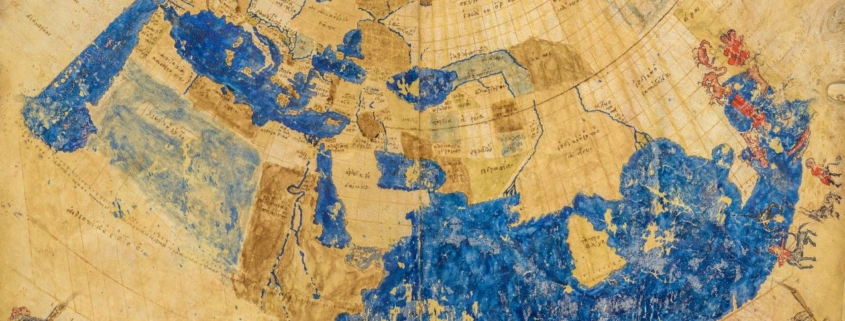
Most people believe the world has already been discovered, measured, indexed, photographed, and rendered into clean layers of data. Maps load instantly, satellites circle endlessly, and coordinates feel final. Yet this confidence rests on a quiet illusion. The surface of certainty hides vast regions of ignorance, not only in remote oceans or uninhabited terrain, but inside the very systems used to define what discovery means. What remains unknown today is not simply what lies far away, but what exists just outside the boundaries of attention, funding, and narrative usefulness.
Discovery has never been a finished act. It is a moving relationship between curiosity and permission. Some places remain unseen because they are inaccessible. Others remain unseen because they are inconvenient, unprofitable, politically sensitive, or difficult to explain within existing categories. The modern age did not eliminate mystery. It reorganized it.
When Maps Become Arguments Rather Than Descriptions
A map is often mistaken for a neutral artifact. In reality, every map is an argument about what matters. Roads are emphasized, borders are sharpened, landmarks are selected, while other features fade into abstraction. What appears as completeness is the result of prioritization. The act of mapping compresses reality into legibility, and in doing so it discards detail that does not serve the intended use.
This selective process shapes discovery itself. Regions that support trade, extraction, defense, or tourism receive constant attention. Regions that do not remain vague. Over time, the vague becomes invisible. It is not that these places are unknown in the absolute sense, but that they are unintegrated into shared understanding. They exist without narrative weight. The consequence is subtle but profound. When a place is poorly mapped, it becomes easier to dismiss, mismanage, or exploit. Knowledge gaps do not remain neutral. They create asymmetries of power.
The Ocean Floor as a Case Study in Selective Ignorance
Despite centuries of maritime exploration and decades of advanced sensing technology, the majority of the ocean floor remains poorly mapped at high resolution. This is not due to technical impossibility. It is due to cost, complexity, and perceived return. Mapping the deep sea is slow, expensive, and yields few immediate commercial rewards.
The irony is that the ocean floor shapes planetary systems. It influences climate, hosts tectonic boundaries, stores mineral resources, and supports ecosystems that regulate atmospheric balance. Yet it receives a fraction of the attention devoted to surface terrain. The unknown here is not an accident. It is a budgeting decision. Discovery, in this context, becomes conditional. We discover what aligns with existing priorities. What falls outside those priorities remains obscured, regardless of its importance.
Lost Places Are Often Actively Forgotten
Some of the most compelling undiscovered spaces are not remote at all. They are abandoned industrial zones, submerged settlements, sealed archives, or altered landscapes whose original forms have been overwritten. These are places erased not by distance, but by disinterest.
Consider cities reshaped by infrastructure projects, valleys flooded for reservoirs, or neighborhoods dismantled through policy. Their histories persist in fragments, photographs, and memories, but lack a cohesive spatial narrative. Without that narrative, they fade from public consciousness. The land remains, but its meaning dissolves. Rediscovery in these cases requires more than excavation. It requires reassembling context. It demands attention to what was deliberately minimized. The act becomes political as much as archaeological.
Discovery as a Function of Attention, Not Distance
Traditional exploration narratives frame discovery as a matter of reaching the unreachable. In practice, discovery is more often a matter of sustained attention. Many environments remain poorly understood because they resist easy study. Dense forests, complex cave systems, urban underground networks, and contested border regions all present logistical and interpretive challenges.
Attention flows toward clarity. Systems that produce clean data attract researchers, funding, and institutional support. Systems that produce ambiguity are avoided. Over time, this bias accumulates. Entire categories of environments become underrepresented in scientific literature, even when they are ecologically or socially critical. The unknown persists not because it cannot be known, but because it refuses to be simplified.
The Limits of Satellite Vision
Satellite imagery creates the impression of omniscience. From orbit, the planet appears flattened into grids of pixels, each seemingly accessible. Yet this vision has limits that are rarely acknowledged. Satellites capture surfaces, not interiors. They record shapes, not functions. They reveal change, but often obscure cause.
Forests may appear intact while their ecosystems collapse internally. Urban areas may seem orderly while informal networks operate invisibly beneath them. Geological instability may remain hidden until catastrophe exposes it. The image reassures even when the underlying system is fragile. This creates a false sense of completion. When everything appears visible, the motivation to look deeper weakens. Discovery becomes cosmetic.
The Role of Technology in Defining What Is Discoverable
Technological tools shape the questions we ask. Lidar reveals ancient structures beneath vegetation. Ground penetrating radar exposes buried infrastructure. Autonomous vehicles explore hazardous environments. Each tool expands the frontier of the knowable, but also narrows focus toward what the tool is designed to detect.
What cannot be easily sensed remains peripheral. Cultural practices, informal economies, ecological interactions, and transient phenomena often escape technological capture. They require human presence, patience, and interpretive skill. In a research environment optimized for speed and scale, these methods are undervalued. The danger is not technological limitation. It is methodological complacency. Discovery becomes whatever the tools can easily register.
Political Boundaries as Epistemic Barriers
Borders do more than restrict movement. They restrict knowledge. Regions divided by political tension often become blind spots in global understanding. Data is fragmented, research access is limited, and narratives become polarized. What is known on one side may be distorted or inaccessible on the other.
These epistemic barriers create zones of speculation rather than understanding. Maps fill with assumptions. Media coverage replaces fieldwork. Over time, these regions acquire mythologies that obscure lived reality. Discovery here requires diplomacy, trust, and long term engagement. It cannot be achieved through remote sensing alone.
The Economics of Curiosity
Curiosity is often framed as a human instinct. In institutional settings, it becomes an investment decision. Funding bodies prioritize projects with predictable outcomes. Commercial entities favor discoveries that can be monetized. Academic systems reward publication velocity over depth.
This economic framing influences what is explored. High risk questions struggle to find support. Slow research is sidelined. Incremental discoveries are favored over foundational ones. The unknown becomes a liability rather than an opportunity. The result is a discovery landscape shaped by incentives rather than significance. What matters most is not always what is pursued.
Rediscovering the Familiar as a Radical Act
Some of the most transformative discoveries involve reexamining what is already assumed to be understood. Urban heat patterns, soil microbiomes, infrastructure decay, and social movement geographies all existed long before they were studied seriously. They were overlooked because they were familiar.
Familiarity breeds neglect. When something is always present, it disappears from analytical focus. Rediscovery requires defamiliarization. It demands that the observer question inherited assumptions and look again with different criteria. This kind of discovery is intellectually demanding because it challenges authority. It suggests that previous knowledge was incomplete, not because of ignorance, but because of framing.
The Ethics of What Remains Undiscovered
Leaving parts of the world unknown is not inherently unethical. However, patterns of neglect often align with patterns of marginalization. Regions inhabited by vulnerable populations are frequently under mapped, under studied, and under represented. Their absence from datasets translates into absence from policy consideration.
Discovery, in this sense, becomes a matter of justice. Who is seen. Who is measured. Who is considered legible. These questions shape resource distribution, disaster response, and environmental protection. Choosing what to discover is choosing what to value.
The Psychological Comfort of Completion
There is comfort in believing the map is finished. It suggests control. It suggests mastery. Acknowledging vast unknowns reintroduces uncertainty, which modern systems are designed to minimize. This psychological preference reinforces premature closure.
Yet history shows that false completion is dangerous. It blinds societies to emerging risks. It encourages overconfidence. It suppresses humility. Discovery thrives on the opposite posture, one that accepts incompleteness as a permanent condition. The willingness to say we do not know is not a weakness. It is the starting point of meaningful exploration.
Discovery Beyond the Physical World
Not all undiscovered territories are geographic. Legal systems, financial flows, algorithmic decision making, and digital infrastructures shape daily life while remaining opaque to most people. These systems are often proprietary, complex, or deliberately obscured.
Understanding them requires interdisciplinary effort. It requires transparency, literacy, and persistence. The discovery here is not about location, but about structure. Who controls what. How decisions are made. Where accountability resides. These hidden architectures influence outcomes as decisively as physical terrain. Treating them as discoverable spaces expands the definition of exploration.
The Future of Discovery as a Cultural Choice
The tools to explore deeper, slower, and more equitably already exist. What remains uncertain is whether societies will choose to use them. Discovery competes with entertainment, extraction, and efficiency. It demands patience in a culture that rewards immediacy.
Choosing discovery means valuing questions that do not resolve quickly. It means supporting work whose benefits may not be immediately visible. It means resisting the illusion that everything important has already been charted. The unknown is not shrinking. It is shifting. What remains to be discovered depends less on technology than on attention, courage, and the willingness to look where rewards are uncertain and narratives are unfinished.

