
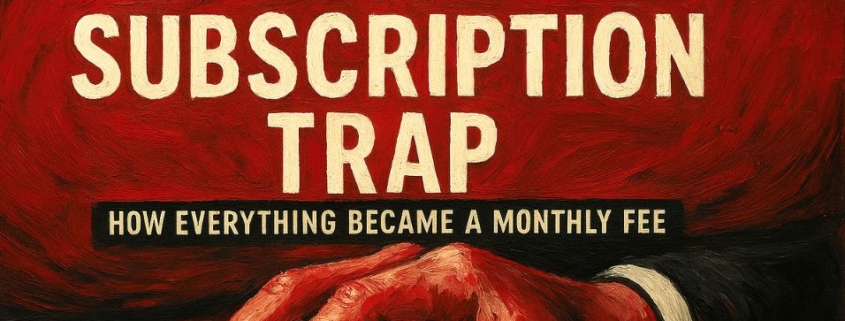
A decade ago, recurring revenue felt like the closest thing business had to gravity. Once you got a customer to pay monthly, you did not just earn money, you earned predictability. Forecasts tightened. Investors relaxed. The company stopped feeling like a sequence of risky sales and started feeling like a machine.
Now that machine is starting to cough.
Not because subscriptions are disappearing, but because the psychological surplus that made them painless is gone. Consumers have learned the pattern. CFOs have learned the pattern. Regulators have learned the pattern. The subscription era trained everyone to accept silent renewal as normal, then asked them to pretend it was convenience. The result is a new business reality where recurring billing is no longer a default advantage. It is a promise that must be continuously justified, and a liability that can backfire faster than it compounds.
The next cycle in business is not about adding subscriptions. It is about surviving after the easy subscription.
When Recurring Revenue Was a Story People Wanted to Believe
Subscriptions did not win solely because they were economically rational. They won because they felt emotionally neat. A monthly fee is psychologically smaller than a large purchase. It spreads pain thinly enough that it slips past the brain’s alarm system. In exchange, the buyer gets the comfort of access, the sense of being a member rather than an owner, the feeling that they are staying current.
For businesses, the narrative was irresistible. Recurring revenue was portrayed as stability, and stability was portrayed as virtue. Analysts loved it because it simplified valuation. Operators loved it because it smoothed cash flow. Marketers loved it because it allowed frictionless upgrades and bundles.
That story got repeated so often that it became an ideology. If you were not subscription based, you were treated as outdated, even if your product did not belong in a monthly box. Companies contorted themselves to fit the model because the model had become the language of legitimacy.
Yet ideology always demands a sacrifice. In this case, the sacrifice was clarity. Customers stopped knowing what they were actually paying for.
The New Consumer Budget Is a Battlefield of Micro Commitments
Subscription fatigue is not only about cost. It is about cognitive load. A modern household has dozens of small obligations that feel individually reasonable and collectively suffocating. They are not perceived as purchases anymore. They are perceived as ambient drains.
A one-time purchase is a decision that ends. A subscription is a decision that lingers. It waits. It renews. It multiplies. Even if the monthly charge is small, the mental footprint is large because it occupies future time.
This is why people are canceling subscriptions that are objectively affordable. The problem is not purely financial. It is the feeling of being managed by invisible timers.
The more a business depends on recurring billing, the more it must contend with that feeling. The moment a customer notices they are paying for something they are not actively using, the business has already lost, because the customer’s relationship to the product has shifted from appreciation to suspicion.
The CFO’s Quiet Rebellion Against SaaS Sprawl
Consumer fatigue is visible, but the corporate version may be more consequential. In many companies, software subscriptions became the easiest way to solve problems quickly. One team needed design tools. Another needed analytics. Another needed a project tracker. Purchases were small enough to avoid intense scrutiny, and they were justified as productivity investments.
Then the bills stacked up.
Executives began to realize that subscription sprawl has a unique kind of inefficiency. It hides in plain sight, distributed across departments, with overlapping capabilities, unused seats, redundant integrations, and contract terms that reward inertia. A company can feel operationally sophisticated while bleeding money through a hundred minor renewals.
The reaction has been predictable. Audits. Consolidation. Procurement friction. Mandatory justification cycles. A new internal skepticism toward vendors who frame every feature as an upsell. The business-to-business subscription market is entering a phase where selling is not enough. Retention requires continuous defense in front of budget owners who are actively hunting for cancellations.
The End of Passive Retention
For years, many subscription businesses benefited from what could be called passive retention. Customers did not stay because they loved the product. They stayed because canceling required attention. The product was sticky not because it was essential, but because the customer was busy.
That advantage is diminishing. People have learned to treat subscriptions as something to periodically prune. The cultural script has changed. Canceling no longer feels like failure or deprivation. It feels like competence.
This shift forces a harder question on businesses. What would retention look like if customers were fully attentive, fully informed, and emotionally unwilling to tolerate wasted money?
The answer is uncomfortable because it exposes how many subscription businesses have relied on friction, not value. The companies that survive will not be the ones that design clever renewal flows. They will be the ones that make customers feel, month after month, that they would actively choose to stay.
The Pricing Model Is Becoming Part of the Product
Subscription pricing used to be treated as a wrapper around the product. Now it is becoming part of the product itself. Customers judge not only what a service does, but whether the payment structure feels honest.
There is a growing preference for models that align payment with actual usage or measurable benefit. If a tool saves time, people want pricing that scales with output, not with the number of users who might log in. If a service provides ongoing value, people want to see that value expressed clearly, not hidden behind tiers designed primarily to extract.
This is why the most successful modern pricing approaches tend to feel legible. They may be complex under the hood, but they communicate a simple principle. Pay for what you use. Pay when you win. Pay once and keep it. Pay annually and get rewarded for commitment. Pay in a way that does not make you feel tricked.
The business implication is enormous. Pricing is no longer a revenue decision. It is a trust decision.
The Regulatory Spotlight on Renewal Behavior
Subscription companies are also facing a changing legal environment around cancelation, disclosure, and renewal practices. Even without referencing any specific rule, the direction of travel is clear. Governments and consumer advocates have become more attentive to dark patterns, hidden opt outs, and friction that intentionally discourages cancelation.
This matters because many subscription businesses were designed in an era when the worst consequence of annoying a customer was a complaint. Now the consequences can include fines, forced changes to flows, reputational damage, and platform level penalties.
Regulatory pressure does not only affect compliance teams. It reshapes strategy. It pushes companies away from extracting value through inertia and toward earning value through satisfaction. It also raises the cost of being sloppy.
If a company’s growth depends on customers forgetting to cancel, the company is operating on borrowed time.
Loyalty Has Been Replaced by Calculation
Subscriptions once implied loyalty. If you paid monthly, you were a member. You were part of something. That emotional framing is weakening.
Consumers increasingly treat subscriptions as tools. They subscribe. They cancel. They return. They rotate through services based on season, mood, need, and promotions. Loyalty is being replaced by calculation, and calculation favors the customer.
In entertainment, people subscribe for a particular show, then leave. In fitness, they join for a routine, then switch. In software, they adopt for a project, then abandon. The modern customer behaves less like a fan and more like a manager.
Businesses can complain about this behavior, or they can accept it and design for it. The companies that will thrive are those that build graceful off ramps and equally graceful re entry, because a customer who cancels is not necessarily lost. They are simply pausing.
A business that punishes cancelation trains customers to leave permanently. A business that respects it invites them back.
Bundling Is Returning, but With New Motives
As subscription overload becomes obvious, bundling becomes attractive again. Bundles reduce the number of decisions a customer must make. They also allow companies to share customer acquisition costs, cross subsidize content or features, and create stickiness through variety.
However, modern bundling is less about convenience and more about defense. It is a strategy to prevent churn by embedding a service inside a larger package that feels difficult to replace. When a customer cancels a standalone subscription, they lose one thing. When they cancel a bundle, they lose an ecosystem.
This can be valuable when the bundle genuinely increases utility. It becomes exploitative when it is used primarily to trap customers through complexity. The line between those two outcomes is thin, and customers are becoming sensitive to it.
Bundles can revive trust, or they can accelerate backlash. The deciding factor is whether the bundle feels like a discount for commitment or a disguise for lock in.
The Return of Ownership and the Appeal of Permanence
There is a counter trend running underneath subscription fatigue, a renewed attraction to ownership. People are tired of paying forever for access that can disappear with a policy change, a platform shutdown, or a price increase. They want things that feel final, durable, and not subject to silent renegotiation.
This is showing up in renewed interest in products that offer a one time purchase, lifetime access, or self hosted control. It is also showing up in the rise of hybrid models, where customers can subscribe for updates and support but still retain a functional version if they stop paying.
For businesses, this is not simply a pricing tactic. It is a strategic posture. Offering ownership communicates confidence. It says the product is good enough that it does not need to rely on hostage dynamics. It also says the company understands the emotional value of permanence.
The companies that ignore this shift will increasingly be seen as extractive, even if their product is strong.
The New Competitive Edge Is Measurable Usefulness
The future of subscription businesses will be less about recurring billing mechanics and more about proving measurable usefulness. The winning products will be those that can demonstrate, with minimal friction, that the customer’s life is better with them. That improvement can be saved time, reduced risk, increased revenue, improved health, deeper learning, or even simple delight.
This has operational consequences. Product teams will need to focus on habit formation without manipulation. Customer success will need to be proactive and specific. Analytics will need to highlight outcomes rather than engagement for its own sake.
This also means that churn analytics will become more brutal. Many companies interpret churn as a marketing problem. It is often a value problem. The customer is leaving because the product is not essential enough to survive scrutiny. Subscription businesses that survive the next decade will be those that treat scrutiny as normal and design their value to withstand it.
Why This Shift Will Produce Better Companies
It is easy to describe the subscription backlash as a threat. It is also a cleansing force. It pushes out businesses that were built primarily on cleverness. It rewards businesses that are built on genuine delivery.
When a company can no longer hide behind renewal friction, it must become more honest. When it can no longer rely on ignorance, it must become clearer. When it can no longer treat customers as passive revenue streams, it must treat them as active decision makers. That is not a sentimental statement. It is a structural one. Markets evolve to punish laziness. Subscription fatigue is simply the moment when customers, at scale, stopped agreeing to be managed.
Some companies will respond with more complicated pricing tables and tighter cancelation flows. Those tactics may work briefly, but they are not a long-term strategy. The deeper strategy is to make the subscription feel like a rational choice, not a lingering obligation. The subscription trap is ending, and what replaces it will not be a single model. It will be a new era of pricing honesty, where the way you charge becomes inseparable from what you are.


The piece succeeds because it treats subscriptions as psychology before it treats them as business mechanics. The line about “invisible timers” captures the real friction, the cognitive weight of decisions that never end. It reframes churn as a shift in consumer self-image, canceling becomes competence, and that is a sharper, more modern diagnosis than the usual “people are price sensitive.”
The argument about ownership returning feels especially important. Subscriptions trained companies to value continuity over confidence, but permanence signals belief in the product itself. Framing hybrid or one-time models as posture rather than tactics reframes the entire debate from monetization tricks to long-term credibility.
What stands out is the idea that pricing has become a trust interface, not just a revenue model. Once renewal is no longer invisible, every charge becomes a statement about honesty and alignment. That makes retention less about optimization and more about moral clarity, which is an uncomfortable but necessary evolution for many SaaS businesses.
I really like the idea that pricing is becoming part of the product, and even part of trust. A subscription can still work, but only when the value feels obvious and the billing feels honest. The return of ownership and permanence also feels real; people are tired of paying forever for access that can change overnight.