
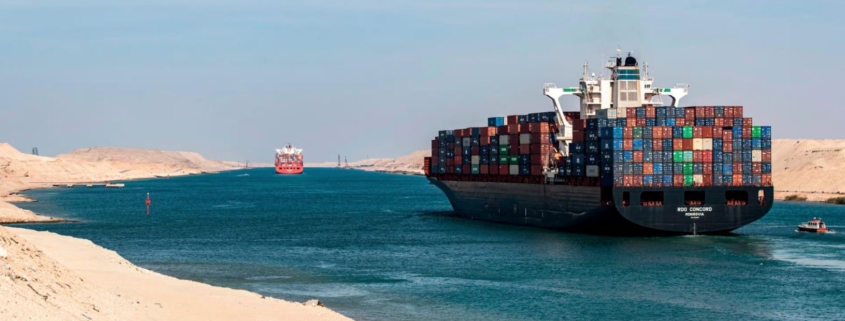
A decade ago, the most dramatic thing a container ship faced on the way from Asia to Europe was a queue. Today, a routing decision can carry the emotional texture of a war report. The map looks the same, but the meaning has shifted. A narrow channel between desert banks is no longer simply a passage that saves time. It is a test of how much uncertainty the modern economy can metabolize without admitting, out loud, that it runs on nerves as much as fuel.
When attacks in and around the Red Sea pushed shipping lines to reroute around the Cape of Good Hope, the detour was framed as temporary, a grim inconvenience that would end when security returned. In practice, it behaved like a stress fracture. It forced a global system built for speed to discover what it actually is when speed becomes optional, expensive, or morally complicated. Now, as some operators begin edging back toward the Red Sea corridor, the question is not whether the shortcut is usable again. The deeper question is what “usable” even means after two years of learning to live without it.
The evidence of the disruption is not subtle. Egypt’s Suez Canal Authority has said revenue in 2024 fell to about $4 billion from a high of $10.3 billion in 2023, and the number of ships transiting was roughly halved, about 13,213 in 2024 compared with more than 26,000 the prior year. Those figures are not just a balance sheet problem for Cairo. They are a clean, brutal proxy for how quickly global trade will move if it believes the sea is unsafe.
But the more interesting story is what happened next, once the detour stopped feeling like an exception and began to resemble a new operating condition.
Shortcuts That Became Front Lines
The shipping industry prefers problems with known shapes. Storms, strikes, port congestion, even a ship stuck crosswise in a canal, these can be priced, scheduled around, absorbed. The Red Sea crisis did something less familiar. It turned a geographic preference into a political gamble. It forced companies to decide whether a shorter path was worth the possibility of missile alerts, sudden crew exposure, cargo delays, or reputational fallout.
The result was not a neat binary of “route closed” or “route open.” It was a patchwork of partial returns, pauses, and cautious experiments. A ship goes through, then another does not. A carrier declares a policy, then adds exceptions, then rewords the policy so exceptions do not look like retreats. That ambiguity was not a failure of planning. It was the only rational posture in a situation where risk was not stable enough to be routinized.
By late 2025, there were signs of a tentative re-entry. Some carriers began testing Red Sea transits again, but the return did not read like a reopening ceremony. It read like a pilot program, carefully bounded by conditions that could be revoked overnight.
That matters because shipping does not simply respond to danger, it translates danger into cost. Once a route is treated as a conflict-adjacent corridor, every stakeholder starts building protective layers. Those layers do not vanish the moment a few ships choose the shortcut again.
Insurance Became a Shadow Tax on Global Trade
In most consumer conversations, insurance is invisible. In shipping, it is often the silent hand that decides what moves, when, and at what price. When the Red Sea risk intensified, the insurance market did what it always does when the probability distribution becomes ugly. It demanded compensation for uncertainty.
War risk premiums, additional coverage requirements, special clauses for transiting particular coordinates, all of this behaves like a private tax system, one that can be imposed quickly and withdrawn slowly. That pricing discipline does not only respond to what is happening. It also responds to what could happen, and it remains stubborn even when headlines quiet down.
This is one reason the “return” of the Suez route is not a simple reversion. Even if attacks decline, the memory of volatility lingers in underwriting models. A corridor that has demonstrated it can become dangerous fast will not be priced like a corridor that has never surprised anyone. The premium becomes a residue of history.
The consequence is that security risk migrates into everyday inflation, but in a way that is hard for the public to see. A household notices a price change, but the causal chain runs through spreadsheets most people never encounter. It is not simply fuel costs. It is also the price of being unsure.
That uncertainty has another effect. It changes which companies can afford to play the game. Large carriers with diversified fleets, strong balance sheets, and sophisticated risk management can experiment with routes, absorb premium spikes, and hedge. Smaller operators, or shippers with thin margins, may have less flexibility. In a crisis, “optional” becomes a competitive advantage.
The Detour Did Not Only Add Distance, It Rewrote Time
The Cape of Good Hope reroute is often described in miles, days, and fuel. That is accurate but incomplete. The more consequential change was temporal. Modern supply chains are built around a faith in predictability. Not perfection, but a reliable rhythm that allows inventory to be lean and scheduling to be tight.
When vessels divert around Africa, schedules stretch, but they also wobble. Port arrival windows become less dependable. Containers miss connections. Warehouses face surges followed by lulls. A retailer may get a flood of product one week and a drought the next, even if the total volume is similar over a month. The system starts behaving like weather.
This is how a disruption becomes cultural inside organizations. Once planners get burned by a few missed windows, they stop trusting the old calendar. They build slack, and slack is expensive. They increase safety stock. They diversify suppliers. They sign longer contracts. They accept higher warehousing costs as the price of not being embarrassed by empty shelves or missed production targets. Some of those decisions will not be reversed quickly because they are not purely responses to danger. They are responses to the revelation that speed was never as guaranteed as the industry liked to pretend.
The detour also forced a kind of honesty about what “just in time” really means. In practice, it often meant “just in time when everything goes right.” The Red Sea disruption made “everything goes right” feel like a naive assumption rather than a business principle.
Ports and Logistics Networks Learned a New Rhythm
When ships reroute, ports do not simply handle the same flow later. They reconfigure labor, storage, and scheduling under strain. Some terminals experience bursts of congestion when diverted vessels arrive in clusters. Others see temporary relief. Feeder networks, the smaller vessels that shuttle containers to regional ports, must adjust to irregular mother ship arrivals.
This matters because the global logistics system is not a single pipeline. It is a choreography of handoffs. If one segment becomes unreliable, the rest must either absorb the disorder or impose stricter controls. Often it does both. Ports tighten appointment systems. Trucking firms adjust staffing. Warehouses re-sequence work.
These adaptations are not easily undone. Once a port invests in new scheduling protocols, or once a shipper restructures distribution to handle irregular arrivals, the crisis becomes embedded in operating habits. The industry does not simply “go back.” It carries the detour forward as institutional memory.
There is a cultural dimension too. Logistics professionals who lived through the rerouting period gained a more skeptical view of “normal.” That skepticism shapes future decision-making. It leads to conservative assumptions, more contingency planning, and less willingness to optimize to the bone. In a world that rewards efficiency, that sounds like a retreat. In a world that punishes fragility, it is strategic maturity.
Egypt’s Loss Was the World’s Signal
The Suez Canal’s revenue collapse in 2024 was not just a national economic event. It was a signpost for how trade behaves under threat. The canal is one of the clearest choke points on earth, a place where disruption is visible and measurable. What made the episode especially revealing is that it was not triggered by a physical blockage. The canal remained there. The water still connected seas. The infrastructure did not vanish. The crisis was psychological in the economic sense. It was about belief. The world decided, collectively but not centrally, that the route was too risky.
That is an unsettling lesson for anyone who assumes global trade is anchored by permanent structures. Structures matter, but trust matters more. And trust can erode faster than concrete cracks.
There is another layer. Egypt depends heavily on canal revenue as a source of foreign currency. When that revenue falls sharply, the ripple effects touch national budgeting, currency stability, and domestic economic policy. The Red Sea crisis therefore connects a shipping decision made in Copenhagen or Marseille to fiscal pressure in Cairo. A detour is never only a detour.
Naval Protection Helped, but It Also Changed the Story
Security responses in the Red Sea have been complex, involving different national efforts and evolving mandates. From a business perspective, naval presence can reduce some categories of risk, but it can also create new uncertainties. Companies must consider how protection might change, how rules of engagement might evolve, and how quickly a local escalation could make yesterday’s calculus obsolete. The market does not only ask, “Is there protection?” It asks, “How stable is the protection, and who bears the consequences if stability fails?”
The implication is that geopolitics has become a line item. Not metaphorically. Literally. Companies now pay for geopolitical volatility through insurance, rerouting costs, and buffer inventory. That does not mean trade is collapsing. It means trade is being repriced.
Climate Arithmetic and the Moral Cost of the Detour
The reroute around Africa did not just add expense, it added emissions. A longer voyage burns more fuel. Even when carriers slow-steam to save fuel, the additional distance is difficult to neutralize. The climate impact is not always front and center in shipping conversations because the industry already lives under a web of efficiency pressures and regulatory expectations. Yet the Red Sea detour forced a blunt confrontation with a reality many sustainability strategies prefer to keep abstract.
If a single security crisis can add so much distance to so many voyages, then emissions targets are not solely a matter of better engines and cleaner fuels. They are also hostage to geopolitics. A supply chain can be designed for carbon efficiency, then be forced into carbon waste by security risk.
This is not an argument that safety should be sacrificed for emissions metrics. It is an argument that the climate conversation about shipping cannot be isolated from the political conditions that govern routes. The ocean is not a neutral space. It is contested, and contestation has a carbon signature.
That signature matters because it will increasingly feed into regulation, consumer expectations, and corporate reporting. A crisis that adds weeks and miles is also a crisis that scrambles sustainability narratives. It forces companies to explain why their emissions rose, and “because violence” is a reason, but not one that fits neatly into annual reports.
Consumers Felt It Without Seeing It
One of the strangest properties of modern logistics is that it is designed to be invisible until it fails. When it fails, the consumer sees empty shelves, delays, and price spikes. When it merely strains, the consumer sees subtler changes. Certain product lines become scarce. Promotions disappear. Delivery windows widen.
Because the Red Sea disruption was not a total stoppage, much of its consumer impact arrived as texture rather than headline. That texture is exactly what makes these events politically and socially important. It creates a low-grade instability that people feel as personal inconvenience and interpret as economic decline, even when macro indicators look tolerable.
The deeper issue is that the public tends to imagine inflation as a domestic phenomenon, something that central banks can tame with interest rates. In reality, a portion of inflation behaves like weather. It comes from distant disruptions, and it does not care about monetary policy in the short term.
The Return Will Not Restore the Old Illusion
If ships flow steadily through the Red Sea again, some costs will fall. Transit times will shorten. Fuel burn will drop. Schedules will tighten. Yet the last two years have changed the mental models of shippers, insurers, and carriers. That shift is durable.
A route that can become dangerous becomes, forever after, a route that might become dangerous. That is not paranoia. It is learning.
The same applies to corporate strategy. Many firms discovered, painfully, that single-sourcing and hyper-lean inventory makes them brittle. They built redundancy. They signed alternative logistics agreements. They invested in supply chain monitoring tools. They rethought what counts as acceptable risk. Those decisions will not be reversed simply because a corridor becomes less threatening for a season.
Even at the level of geopolitics, the crisis altered expectations. It reminded governments and companies that maritime trade routes, often treated as background infrastructure, can become strategic battlegrounds quickly. That lesson will shape naval budgets, diplomatic priorities, and corporate planning.
A shortcut can reopen. Confidence is slower. The waterway can carry ships again, yet the system now knows what it looks like when the ships choose not to come, and that knowledge sits quietly behind every quote, every premium, every delivery date, like a second map drawn in invisible ink.


I found the point about time more revealing than distance. The detour rewired expectations around predictability, not speed. Once companies learn to live with wobble, they do not rush back to fragility. The shortcut may reopen, but the old faith in smoothness is unlikely to return.
I never thought about how much “trust” matters in logistics, but that’s exactly what this is. The canal didn’t disappear; confidence did.
Really strong writing here. The idea that global trade runs on nerves as much as fuel feels completely accurate right now.
This article makes it clear that even if the route returns, the mindset doesn’t. Once risk becomes part of the map, it never really leaves.
The point about insurance becoming a shadow tax on trade is so real. Most people never see that part, but it ends up shaping prices and delays in everyday life. The ripple effects are bigger than most realize.
This was a great read. It really shows how shipping routes aren’t just about distance anymore, they’re about risk and uncertainty. Even if the corridor “reopens,” the confidence doesn’t come back overnight.