
A garden is full of things that want to sprawl. Tomatoes throw themselves outward and downward, beans reach in loops, cucumbers drag their ambition across the soil, peas tangle into knots that seem to form overnight. Left alone, many plants will still grow, still flower, still fruit, but the garden becomes a place where effort is spent untangling rather than cultivating. This is why support systems matter, not as accessories, but as infrastructure. A trellis is not merely a structure for vines. It is a way of deciding what kind of garden you are building, one that manages space, light, airflow, harvest, disease pressure, and even the psychology of how a person moves through a season.
Vertical growing is often sold as a hack for small spaces. That is true, but it is also a design philosophy that changes the entire logic of planting. It turns the garden from a horizontal puzzle into a layered environment, where the surface is not the only plane that counts. The moment you commit to trellising, you stop thinking like someone placing plants on a bed and start thinking like someone shaping a living canopy.
Why Vines Sprawl in the First Place
Climbing plants evolved a strategy that is both elegant and opportunistic. Instead of investing energy into thick trunks or rigid stems, many vines invest in rapid extension and attachment. Tendrils, twining stems, and petiole wrapping are ways of outsourcing structure to the surrounding world. The plant does not need to build a tree. It only needs to find one.
In a natural setting, that surrounding world is brush, shrubs, dead branches, grasses, and neighboring plants. In a garden, the surrounding world can be engineered. When a gardener provides a trellis, they are essentially offering the plant a predictable environment to climb. That predictability matters. It reduces stress from stems bending under weight, reduces damage from fruit resting on wet soil, and allows the plant’s energy to be directed into growth and reproduction rather than repeated attempts to find something to grab.
The vine does not become more disciplined because the gardener wants order. It becomes more effective because the garden gives it a clear path.
The Hidden Payoffs of Getting Plants Off the Ground
The most immediate benefit of vertical growing is space. The less obvious benefits often matter more.
Airflow changes everything. When leaves are lifted and spaced, they dry faster after rain or watering, and that drying time is one of the most important variables in fungal disease. Many common garden problems are not mysterious. They are humidity and leaf wetness problems. Trellising does not eliminate pathogens, but it makes the environment less favorable for them. A plant that dries quickly becomes a less hospitable host.
Light distribution also improves. Leaves on the ground shade each other unevenly, and fruit can be hidden under dense foliage, ripening slowly and irregularly. When the canopy is arranged vertically, light can reach deeper into the plant, often improving yield quality and making it easier to see what is happening. This is not just convenience. It changes how a gardener can respond to problems early, before they become a full season loss.
Then there is the harvest. Anyone who has hunted for cucumbers in a sprawl knows the strange experience of missing one until it becomes a thick, bitter club. Vertical growing makes the plant legible. It turns harvest into observation rather than scavenger work.
Trellises as Garden Architecture
The common mistake is treating a trellis like a stake, a single object placed near a plant. A useful trellis is more like architecture. It has to resist wind, carry weight, and last through a season that will test it with storms and the cumulative mass of growth.
A trellis must also be proportionate. A delicate string support can work for peas, which are light and cooperative. It may fail catastrophically with a vigorous indeterminate tomato or a heavy cucumber vine loaded with fruit. The correct structure depends on the plant’s climbing behavior, growth rate, and mature biomass.
It also depends on the gardener’s own habits. Some people like tight rows and formal systems. Others prefer an improvised approach that evolves through the season. A trellis should support the gardener as much as the plant. A support system that is irritating to maintain will be abandoned, and then the plants revert to sprawl. Good garden infrastructure reduces friction. It makes the right behavior the easy behavior.
The Major Trellis Families and What They Are Good For
There are endless variations, but most trellis systems fall into a few functional families, each with distinct advantages.
An A frame trellis creates a stable triangular form. It is naturally resistant to wind and can support climbing crops on both sides, which makes it efficient in a bed where access from both sides is possible. The shape also creates shade underneath, which can be used deliberately for heat sensitive plants or for extending the season of greens.
A vertical panel trellis, whether made of cattle panel, wire mesh, or wooden lattice, is easy to install along a bed edge or fence line. It allows plants to climb in a relatively flat plane, which makes pruning and harvesting straightforward. It also allows the gardener to treat the trellis as a wall of production, almost like a living fence.
Strings and netting systems create a flexible trellis that can be adapted to many crops, especially peas, pole beans, and some flowers. They are lightweight and inexpensive, but they require solid anchors. A string system is only as strong as the posts holding it.
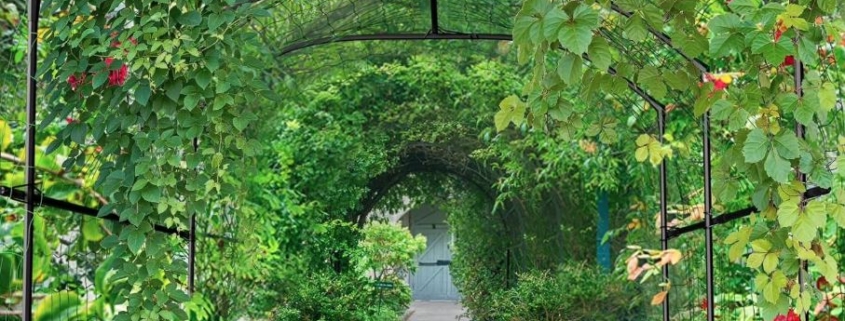
Arches create a walkway canopy. They can be beautiful, but beauty is not their only function. An arch allows crops to grow upward and then cascade down, which can be useful for cucumbers, gourds, and even some varieties of beans. The arch format also allows the gardener to harvest from both sides and from below. It makes the garden interactive in a way that changes how people move through it.
Cages, especially for tomatoes, are a distinct category. They are not technically trellises in the climbing sense, but they perform the same role of containing growth in three dimensions. A well built cage can support a tomato plant with minimal tying, but many store bought cages are too small and too weak. They become decorative failure objects by mid season.
Each system implies a style of management. The trellis is not just a support. It is a commitment to a certain relationship with the plant.
Matching Plants to Structures
Plants climb differently, and this matters more than people assume.
Peas use tendrils that latch onto thin supports. They prefer netting, string, or slender twigs. Give peas a thick post and they will struggle, not because they are weak, but because their attachment strategy requires a certain scale.
Pole beans twine. They wrap their stems around supports. They prefer poles, string, or anything they can spiral. They can climb mesh, but they do best with vertical lines they can wrap around confidently.
Cucumbers use tendrils and can attach to mesh, netting, and strings. They can be trained, but they sometimes need help early, guiding the vine to the support until it catches.
Tomatoes are not true climbers. They are sprawling plants that can be trained upward through tying and pruning. A tomato trellis is really a management system. It is a way of deciding whether you want a single stem plant or a sprawling bush. This decision affects everything, including airflow, fruit size, and ease of harvest.
Squash and melons can be trellised, but their weight changes the equation. Small fruited varieties can climb well. Large melons require strong structures and sometimes slings to support fruit. This can be done, but it is a deliberate choice, not an afterthought.
The best vertical gardens are those where the structure respects the plant’s natural behavior while shaping it gently.
Training, Not Forcing
The difference between successful trellising and constant frustration is timing. A vine is easiest to guide when it is young and flexible. Wait too long, and the stem becomes brittle, or the plant becomes committed to a direction that requires harsh bending to correct. A gardener then ends up snapping growth points, losing flowers, or creating wounds that invite disease.
Training is not a one time act. It is a relationship that evolves through the season. In the early phase, the gardener’s job is to introduce the plant to the structure. In the mid phase, the job is to keep growth distributed so it does not bunch into dense mats. In the late phase, the job is to maintain access and prevent the structure from being overwhelmed.
The goal is not perfect geometry. The goal is a plant that can breathe, fruit, and be harvested without constant struggle.
Pruning as Companion to Trellising
Trellising without pruning can still produce benefits, but pruning is often the difference between a vertical garden that feels clean and one that becomes a jungle on a wall.
Pruning is not about making plants behave like ornaments. It is about allocation. Plants will produce more stems, more leaves, more lateral shoots than a gardener can manage. Some of that growth is useful for photosynthesis. Some of it becomes self shading clutter that increases humidity and blocks airflow.
In tomatoes, pruning determines whether the plant becomes a few thick, fruit heavy stems or a mass of green. In cucumbers, removing lower leaves that touch the soil can reduce disease spread. In pole beans, thinning excessive tangles can improve pod production and reduce issues that appear when the canopy becomes too dense.
Pruning also changes the gardener’s attention. It forces observation. A person who prunes is a person who notices. They see early pest infestations. They see nutrient stress patterns. They see flower development. Trellising makes observation easier, and pruning makes it purposeful.
Trellising and Pest Ecology
Vertical growing changes pest dynamics in complex ways. Sometimes it reduces problems. Sometimes it introduces new ones.
When fruit is off the ground, soil dwelling pests and rot organisms have less access. Slugs, for example, often cause less damage when leaves and fruit are lifted and the soil surface is kept drier. Some fungal diseases are reduced because leaves dry faster.
However, a vertical wall of foliage can also become a highway for certain pests. Aphids can colonize tender new growth quickly. Spider mites may thrive if a vertical system creates warm, dry microclimates, especially in hot weather. The key is that vertical growing does not eliminate pest pressure. It changes the battlefield.
The gardener’s advantage is visibility. A trellised plant is easier to inspect. You can see the undersides of leaves. You can spot eggs, webs, and early damage. In a sprawl, pests hide in the interior. In a vertical system, the interior is exposed.
Wind, Weight, and the Physics of Failure
A trellis can look stable when it is empty. It can fail spectacularly once loaded.
Wind exerts leverage. A tall trellis with dense foliage becomes a sail. The force is not just downward. It is lateral. Posts can loosen. Twine can snap. Entire frames can tilt. The failure often happens at the worst time, when the plants are heavy and fruiting. Repair becomes difficult without damaging crops.
Weight is cumulative. Cucumbers might feel light at first, then suddenly the vine is carrying multiple fruits at once. Pole beans can create thick living curtains. Tomatoes loaded with wet foliage after rain become surprisingly heavy. This is why good trellis design starts with the assumption that everything will be heavier than expected.
Anchoring matters. Posts should be driven deep. Connections should be tight. Materials should resist rot for the duration of the season. A trellis that fails teaches a harsh lesson about underestimating the physical reality of plants.
Vertical Growing as a Way to Garden Longer
One of the most underrated benefits of trellising is season extension, not through technology, but through management.
A garden with good airflow and accessible harvest is easier to keep productive into late season. Diseases are less likely to explode. The gardener is more likely to stay engaged because the garden remains manageable. When the garden becomes chaos, many people mentally abandon it, and abandonment accelerates decline.
Vertical systems can also allow gardeners to plant beneath or beside climbers strategically. The shade created by an A frame can protect lettuce from summer heat. A trellised cucumber wall can provide partial shelter for herbs. A grapevine on a pergola can create a microclimate for understory plantings.
In this way, trellising becomes more than support. It becomes a tool for sculpting time, allowing certain plants to thrive outside their usual window.
The Aesthetic Dimension That Actually Matters
People often treat garden aesthetics as shallow, but the appearance of a garden affects how people interact with it. A garden that feels orderly invites attention. It becomes a place you want to visit daily. A garden that feels chaotic can trigger avoidance, and avoidance is one of the most consistent predictors of failure.
A trellis introduces vertical lines and intentionality. It makes the garden feel like a designed space rather than a collection of plants. This design has practical consequences. It encourages maintenance. It encourages harvesting. It encourages curiosity.
The garden becomes less of a chore and more of a place, a space that rewards presence. That shift matters, especially for gardeners who are balancing work, family, and the constant pull of distraction.
The Trellis as a Commitment to Clarity
A trellis does not solve every garden problem. It does not make pests disappear. It does not guarantee abundance. What it does is force clarity. It makes the gardener decide how plants will occupy space. It makes management visible. It turns the garden into something that can be read, adjusted, and understood.
This is why vertical growing often feels like a leap in skill, even when it is built from simple materials. The gardener is no longer reacting to sprawl. They are shaping growth. They are treating plants as living systems that respond to structure, training, and attention.
In the end, the trellis is less about vines than about intention. It is a quiet declaration that the garden will not be left to chaos, not because chaos is immoral, but because the gardener wants to spend the season growing food and beauty rather than untangling regret.

