
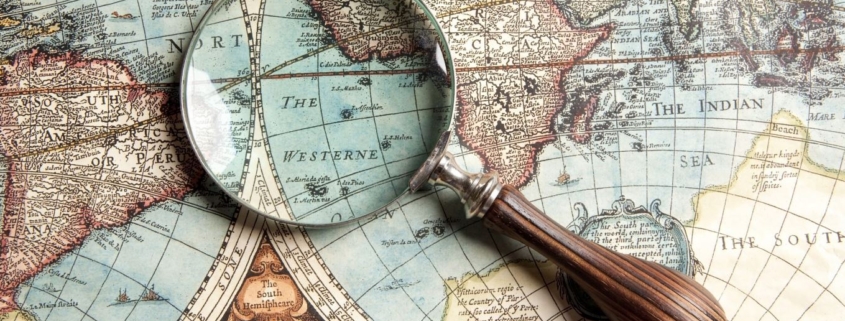
Discovery no longer looks like conquest or revelation. Satellites have traced coastlines. Databases catalog species. Street level imagery records entire cities down to curbside graffiti. By most measures, the planet has been thoroughly documented. And yet, the feeling that something essential remains undiscovered has not faded. It has intensified.
This tension defines the modern age of discovery. We live surrounded by information while sensing that meaning still hides in places data cannot fully describe. The unknown has not vanished. It has shifted location, from blank spaces on maps to overlooked layers within what we think we already understand.
The mistake is assuming discovery ends when something is visible.
For centuries, discovery was tied to distance. To discover was to travel far enough to encounter something unrecorded. The act carried risk, uncertainty, and often violence. Those histories still matter, but the model itself no longer fits the present. Today, distance is cheap. Visibility is constant. What remains scarce is attention capable of noticing what familiarity conceals.
The most consequential discoveries of the coming era will not emerge from reaching farther. They will come from looking differently.
When Knowing Everything Makes It Harder to Notice Anything
Information abundance creates a paradox. The more we know, the easier it becomes to overlook significance. Patterns hide inside noise. Subtlety disappears beneath summaries. Complexity gets flattened into digestible explanations that feel complete even when they are not.
Search engines answer questions efficiently, but they also frame inquiry narrowly. You ask for what you already suspect exists. Algorithms anticipate interest based on past behavior. Curiosity becomes guided, then constrained, then quietly domesticated. Discovery requires friction, and modern systems remove friction by design.
As a result, vast territories of understanding remain unexplored, not because they are inaccessible, but because they are not easily surfaced by existing tools. They sit between categories, outside trends, beneath metrics.
This is why many breakthroughs now arrive sideways. They are noticed by accident, through misclassification, boredom, or sustained attention to something others skim past.
Rediscovering the Ordinary
Some of the richest discoveries are not exotic. They are mundane phenomena examined with unusual seriousness. Urban planners notice how informal paths worn into grass reveal better design than official sidewalks. Linguists observe how slang evolves faster than formal grammar, revealing social shifts long before surveys do. Historians uncover entire worldviews embedded in shopping lists, marginal notes, or discarded letters.
These insights require patience rather than ambition. They reward people willing to linger with what appears trivial. In a culture that prizes novelty, the ordinary becomes invisible, even though it contains dense information about how people actually live.
Discovery, in this sense, is less about uncovering new objects and more about restoring depth to familiar ones.
The Hidden Geographies of Everyday Life
Modern maps excel at representing physical space. They struggle to capture lived experience. Two neighborhoods separated by a street may belong to entirely different social worlds. A public park can function as a sanctuary at one hour and a site of tension at another. These micro geographies shape behavior, opportunity, and belonging, yet they rarely appear in official representations.
Anthropologists, journalists, and artists who embed themselves long enough to notice these distinctions often reveal realities that statistics alone miss. Informal economies, mutual aid networks, and cultural codes operate quietly alongside formal systems. They are discovered not through extraction, but through participation.
These discoveries matter because policy, design, and planning often fail when they ignore them. Solutions built on incomplete maps solve imaginary problems while leaving real ones untouched.
Lost Knowledge in Plain Sight
Discovery also moves backward. Entire bodies of knowledge have been sidelined, dismissed, or forgotten because they did not fit dominant frameworks. Indigenous land management practices, traditional ecological knowledge, and localized engineering solutions were often replaced by standardized approaches that promised efficiency and control.
As modern systems strain under climate pressure and resource limits, many of these discarded methods are being rediscovered, not as nostalgia, but as viable alternatives. Controlled burns, polyculture farming, and vernacular architecture demonstrate resilience precisely because they evolved in dialogue with specific environments.
The rediscovery process is complicated by power dynamics. Who gets credit. Who gets consulted. Who benefits. Discovery without humility risks repeating extraction under a new name.
True rediscovery requires acknowledging that progress is not linear, and that wisdom does not always announce itself in modern language.
The Inner Frontier
Not all discovery concerns the external world. One of the least explored territories remains the inner landscape shaped by attention, memory, and perception. Neuroscience has mapped brain regions and neural pathways, yet subjective experience remains resistant to full explanation.
Practices like meditation, journaling, and deep reflection are often treated as self help rather than serious inquiry. Yet they reveal patterns of thought, bias, and emotion that influence behavior at every scale. Understanding how attention drifts, how narratives form, how identity solidifies offers insight into decision making, creativity, and conflict.
This kind of discovery lacks spectacle. It produces no dramatic images. Its results are difficult to quantify. Yet its implications ripple outward, affecting how people relate to technology, work, and one another.
The reluctance to treat inner exploration as legitimate discovery reflects a cultural preference for external proof over internal understanding.
Discovery in the Age of Synthesis
As specialization deepens, discovery increasingly happens at intersections. Breakthroughs emerge where disciplines overlap, where assumptions collide, where methods migrate across domains. A biologist borrows tools from computer science. An artist collaborates with an engineer. A historian uses data analysis to reinterpret archives.
These hybrid discoveries require translation as much as insight. They depend on people who can hold multiple languages of thought without forcing them into premature coherence. The challenge is not generating information, but integrating it meaningfully.
Institutions often lag behind this reality. Funding structures, academic departments, and professional incentives still reward narrow expertise. The work of synthesis remains undervalued even as it becomes more essential.
Discovery accelerates when boundaries soften.
The Cost of Assuming There Is Nothing Left to Find
Perhaps the greatest threat to discovery is complacency. The belief that everything important has already been identified breeds intellectual stagnation. It narrows curiosity and justifies indifference. When societies assume the unknown has been conquered, they stop listening for what does not fit.
History offers repeated warnings. Civilizations that mistake dominance for understanding often overlook vulnerabilities until collapse exposes them. Environmental tipping points, social fractures, and technological side effects tend to emerge from blind spots rather than mysteries.
Discovery is not about claiming mastery. It is about maintaining openness to being wrong.
Why Discovery Still Matters
Discovery shapes how societies adapt. It reveals options that were invisible under old assumptions. It reframes problems in ways that unlock new responses. Without discovery, systems ossify. They repeat solutions long after conditions change.
The modern challenge is not finding new territory, but preserving the mindset that discovery requires. Curiosity without guarantee. Attention without immediate reward. Respect for complexity over speed.
The world does not need to be rediscovered as an object. It needs to be rediscovered as a process, one that remains unfinished, layered, and resistant to final explanation. What remains undiscovered is not hidden because it is far away. It is hidden because it asks us to slow down, look again, and admit that knowing something exists is not the same as understanding it.

